Pages

Showing posts with label We Are Church Ireland. Show all posts

Sunday, June 9, 2019

TINA BEATTIE


Click on any image for a larger version

I had seen Tina Beattie once on telly chairing a discussion and she impressed.

So, when We Are Church Ireland, for which I have a certain affection, decided to invite her over from the UK to give one of their talks, I figured I was not going to miss it.

Got my ticket in good time and was looking forward to it when it suddenly transpired that I'd have to forgo a cremation (not my own, yet) to attend. So I thought this had better be good.


I got to wonder beforehand if Tina would have ever heard of my hero Anne Bieźanek. That was a long time ago and my impression was that she had been forgotten by all bar her family and myself.

When I asked Tina I was amazed at her reply. Someone had just written an article about Anne in a Catholic Women Speak magazine and she is to send me a copy. So, that was off to a good start.


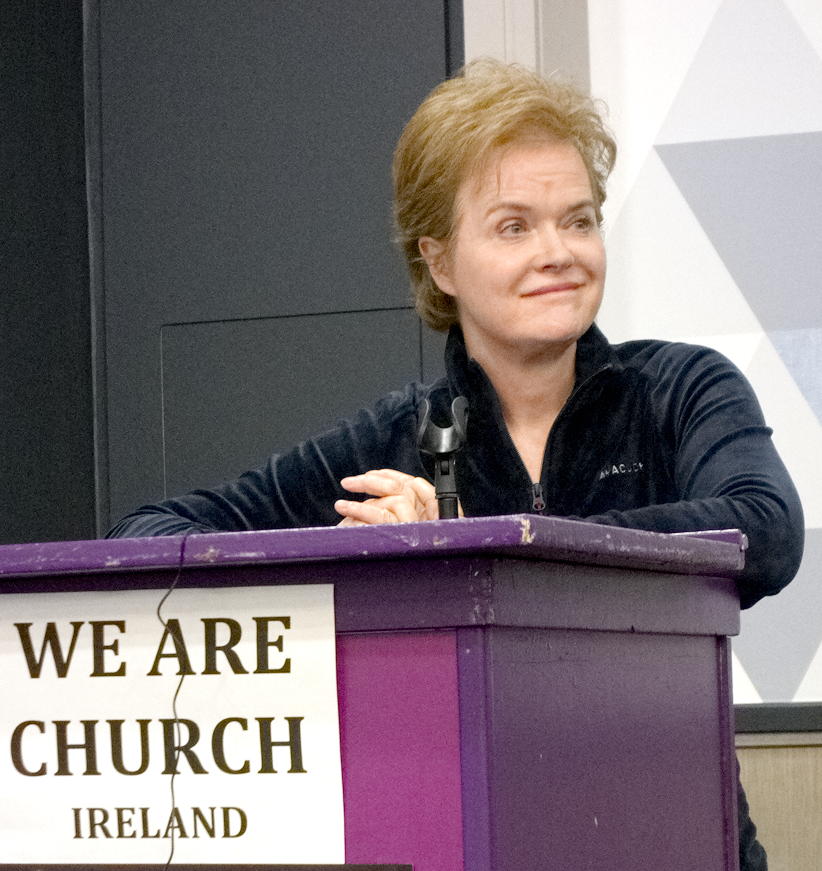
Tina's talk, as you can see from the image at the head of this post, was about women in the Roman Catholic (Apostolic and Universal) Church. She has intriguingly distinguished in the title between Hope and Optimism.

And she went on at the beginning to present us with three further distinguishing headlines: Memory versus Nostalgia; Imagination versus Fantasy; Reality versus Unreality.

You may wonder at these distinctions, but when you've heard the talk you'll know it's about walking the walk. In each case the first term is pressed into active service and the second is a passive alternative.


Hope versus Optimism: where Optimism is taken as just hanging around and expecting the future to be better without having to do anything about it. This is the drug that the church hierarchy are peddling to us and to women in particular. Hope, on the other hand is taking action and hoping to change things.

Memory versus Nostalgia: where Nostalgia is a hankering after the past (which may never even have existed). This is what the Church is doing with its millennium tradition of excluding women from ministry. An immutable past whether real or not. Memory involves re-examining and questioning the past and using this to support change for the better.

Imagination versus Fantasy: where Fantasy is deluding oneself that thing are better now, or at least they look better in the mind. I won't comment on this one as it might get me into trouble. Imagination is having the courage to imagine things differently and do something to help bring it about.

Reality versus Unreality: I think that one speaks unambiguously for itself.

Now I'm not saying the above words were Tina's own. They're mine. But they are what I took away from the talk as interpretations of these provocative headlines.

If there is a single word to describe the essence of the talk it's activism.


Referring to the Synod of Bishops on Youth held in Rome in October 2018, Tina pointed out that though women religious (nuns) got to attend this synod they did not have any votes unlike their male religious counterparts.


Ursula Halligan

Women protested peacefully outside at various defects in the Synod from their point of view and police attempted to "robustly" move them on.

We were treated to a video of this police exercise and who did we spot in the middle of it all, loudly protesting and waving her hands in admonition, but our Ursula. A Roman film star no less.


Tina told us how she had once complained, I think it was to a member of the hierarchy, at the constant use of the term "man" in describing human affairs. She was given the old line of "when I say man I embrace woman" smart rubbish. Well then she says what about when you ordain men, is that not supposed to include us? Oh, but you're a woman, was the reply.

I don't think she threw a brick at him, she's not that way inclined. However, had she done so I'm sure no jury of twelve women would have convicted.

Tina also challenged the traditional definition of the Magisterium the teaching core and repository of the church's wisdom. Some definitions would have confined this to the Pope and the CDF. But no matter how much it was broadened it never went beyond the hierarchy and maybe a few high power kosher theologians.

But enter the sensus fidei and it's a different story entirely. Then nothing becomes official teaching unless it gains wide acceptance among the faithful. As Tina pointed out, on that basis Humanae Vitae, ignored/rejected by 90% of Catholics, is not part of church teaching, much less infallibly so. Tony Flannery has also frequently made this point regarding the Magisterium.


Tina told us about the forum she had set up called Catholic Women Speak which allows women to work together to create the space for dialogue, theological exploration and collaboration among Catholic women in the worldwide Church.

You can check out the public site for stories and interviews. Many of the points Tina made in the course of her talk can be found here (and a lot more besides).


Now, I'm not an ankle man myself but I'm sure in the age of Joyce this sight would have turned many a male head.

However it was Tina heself who directed our gaze at her red slippers. I didn't catch the full story but I think they may be the equivalent of the Freemasons' handshake among a group of progressive women.


On to the Q&A. I'm not going to say much about this beyond it was very positive in the sense of supporting Tina's point of view. My attitude at Q&As is the following. If nobody pipes up I'll ask a question, no matter how trivial, to get the ball rolling. If people do speak up I wait and if their questions seem more important than mine I let them at it.

Well this was a session of heavies which included a female theologian, a veteran feminist and an Anglican man from Newry. So I kept my mouth firmly shut and saved my question for another time when it might be more needed.

You'll gather from the sequence of shots below that it was an animated session.


And finally the formal unveiling of the real last supper and not the one colluded with by Leonardo da Vinci, designed to copperfasten the male priesthood in perpetuity. There are women and children in this one as Tina was quick to point out.

About Nora Kelly's LAST SUPPER

This painting of the Last Supper includes 6 women and 3 children, as well as Christ and His 12 apostles. Most classic paintings of the Last Supper (like Leonardo DaVinci’s Masterpiece) only show Christ and His 12 male apostles. But we know from scripture that Christ’s women disciples and His mother Mary had followed Him from Galilee up to Jerusalem, and the next day it was the women who were at the foot of the cross when the men ran away. This painting also shows a traditional Jewish Passover meal, with all the men wearing prayer shawls, eating with their right hands and reclining around a low table on cushions and rugs. On the right side of the painting can be seen the basin and a towel from the washing of the feet.


And finally, her own copy of the picture as a parting gift from WAC.


And a proper look.

Tina's talk on Youtube

Q&A on Youtube

Unveiling the Last Supper


Thursday, April 11, 2019

WHERE ARE YOU REALLY FROM?


This is how you welcome immigrants - not with a wall, not with cages, not with vast unsanitary under-resourced camps - but with a hug.

More of that later.


Colm Holmes

We Are Church Ireland is a group of Roman Catholics who are attempting to reform the antiquated, mired-in-the-middle-ages, Roman Catholic Church. These are not Molotov-cocktail revolutionaries. The are ordinary people, many of them quite conservative in other areas of their lives but all on a mission of salvation - to save the Roman Catholic Church from going down the tubes or from reducing itself to a fascist totalitarian clique.

Their five "outrageous" demands are:
  1. Equality of all the baptised where decision making is actively shared by all, with appropriate structures for this.
  2. Full participation of women in all aspects of church life, including priesthood.
  3. Recognition of the primacy of an informed conscience.
  4. Promotion of a positive attitude towards sexuality and the removal of the obligation of clerical celibacy.
  5. An inclusive church, open and welcoming to all, which does not marginalise people because of their sexual orientation, marital status or for any other reason.

Welcoming all to the meeting, Colm reminded us of the five aims - sort of setting a context.


John Farrelly

John took the opening prayer, which is customary at the beginning of each meeting. This was one with a difference, laced with a bit of Transcendental Meditation or Mindfulness or something.


Ursula Halligan

Ursula then took over the role of MC and introduced us to the night's speaker: Sheila Curran RSM with a talk entitled
IMMIGRATION: Welcoming the Stranger; a Challenge and Opportunity; a faith perspective.
And what was I doing there? I was inclined to wonder about that myself - coming along to listen to a Mercy Nun talk about immigration.

Well as it happened it was less of a talk and more of a challenge. And this was no run of the mill nun, if there is such a thing. Apart from her impressive academic qualifications, she has worked with the poor both at home and abroad, but what caught my eye was her having worked with liberation theologian, Gustavo Gutiérrez.

Now, liberation theology, which essentially meant putting the welfare of the poor ahead of dogma, was roundly condemned by the now Saint John Paul II, and it played an significant role in the path of discernement of the current Pope. On top of this, a stint in South America has tended to radicalise those religious who go there. So, to answer the question, I was curious.


Sheila Curran

Sheila did not disappoint. From the word go, she was on the offensive. And there is something about a northern accent that penetrates your defences.

She briefly genuflected in the direction of the MOPE meme, but quickly turned it on its head to illustrate that we should know better and had no excuse.

Yes, there were the coffin ships and, despite all, Irish America came of age as one of the most powerful lobbies in the States. But it still felt itself a cut above the Hispanics. We have no monopoly on virtue.


Sheila brought us further down to earth with a bang.

How had Ireland of the Welcomes treated refugees from Northern Ireland in 1972? Welcome, as long as they were going back soon and meanwhile showed the gratitude expected of them. And by the way, none of your Northern disruption down here, thank you.

And these were our own. What might real foreigners expect? Direct provision? Effectively a denial of human rights and, for the many, long term incarceration. And most of this hidden away, off the public radar.


And human trafficking? Sure we're dead against that.

But what about the honey-pot ad posted of a young woman offering sexual services, and with a phone number. When she answered the phone she explicitly claimed she was being trafficked, and this was competely ignored by the callers. What was the predominant accent of the callers? Ireland of the Welcomes.


So what should we be doing?

Taking our fair share of refugees for a start, welcoming them into communities and allowing them to work. They have much to contribute and have a right to a reasonable life.


Nieves Fernandez

Nieves has been an immigrant into a number of countries and she made the point that people are people no matter where you go. She was apprehensive on occasions starting in a new country but found that the people "were just like us".


I could go on but if you're interested you can look in on Sheila's talk/challenge on the night. It is in three parts of 15 minutes each:
Part 1  Part 2  Part 3.

And you can also gen up on Sheila's wider take on life at the Mercy International website.

Previous meetings:  Josepha Madigan   Gabriel Daly

Wednesday, February 13, 2019

SAINT JOSEPHA SAYS MASS


Josepha Madigan
Click on any image for a larger version

This might as well have been the headline when, on 28 June 2018, Josepha, who is a member of the Mount Merrion Parish Team, stepped up to the plate and took a prayer service when the priest failed to turn up to say mass.

Much of the media could not resist the temptation and had her saying mass, even if they did put it in quotes. The backlash was immediate from fundamentalist Roman Catholics and even Archbishop Martin was critical. But it was FAKE NEWS.

The fact that Josepha is an advocate of women's ordination to the RC priesthood only added spice to the story. Of course she is also the Culture Minister in the current Irish Government but that should really have nothing to do with her acts or opinions as a private individual and a Roman Catholic woman of faith.


It was in this latter capacity that the progressive Roman Catholic organisation We Are Church - Ireland (WAC) invited her to address them at one of their monthly meetings.

So far so good. But Josepha was also her party, Fine Gael's, coordinator in the recent referendum on removing the Constitutional ban on abortion. Now, abortion is a very sensitive issue. The Roman Catholic Church's view on it is clear - it is a grave sin. Full stop. However, the people of God have more nuanced views on the matter and the referendum was carried by 64.5% of voters.

Anyway, the WAC meeting was to be held in the organisation's usual venue, the Mercy International Centre run by the Mercy Nuns. Following threats of protests and intimidation of a staff member, the nuns withdrew the meeting room and WAC had to find an alternative which turned out to be the Stillorgan Talbot Hotel.

The photo above shows the room about an hour before the meeting. I had intended going to the original meeting but now felt an additional obligation to show some solidarity with the organisers.

It was not clear whether the protesters would be satisfied to have bounced the meeting out of a religious and into a secular location, or whether they would turn up at the hotel in their busloads and attempt to disrupt the meeting. So there was an element of tension in the air.

I gather that a few protestor did turn up outside and, had I known at the time, I'd have gone out and taken a photo.


Colm Holmes

But back to the main event. Colm welcomed the attendance and reminded them that WAC meetings start with a prayer.


Nieves Fernandez

Nieves read a prayer which, as far as I recollect, celebrated the harnessing of nature to the spiritual life. I'm sure she'll correct me if I'm wrong. One of the problems in taking photos at these events is that you can actually lose the thread of what's going on while concentrating on the photo. [Just found it online]

Following the prayer, Colm gave the floor to Ursula Halligan who was to guide us through the evening.


Ursula Halligan

Ursula is a veteran and she didn't waste any time calling on Josepha to speak to her motion, which was "Why the Catholic Church should open all ministries to Women".


Now I'm not going to paraphrase what Josepha said. You can read her text here or on the WAC site, though the text there is quite small, or on Josepha's own website.

Instead I'll just include a few extracts which struck me as particularly relevant. You'll see from the full text that she touched all the required bases in the course of her talk.

On the rubbish about her having said mass:
This is of course, not the case at all. Although I opened the prayers it was the three of us women together who shared the elements of the mass that we could still perform as lay people. It would have been a terrible shame after making the effort to attend mass that the congregation then had to return home with no instruction whatsoever. We only did what many other women and indeed men are doing around Ireland. Our involvement was a reminder of the role of women in Church Ministry in general. I received letters, cards and emails from all around the country from Clare Island to Dublin where more women but some men told me of their daily, weekly and monthly involvement in assisting in their local parish church. The Church calls for us all to break bread together at Mass, and women are playing a role in Ministry and the liturgy at several levels across the country and the world. In my view, as a Catholic, it should not come a source of surprise to see a woman on the altar including in the priesthood itself.


On the nature of a priestly vocation:
In his [Bishop Crowley's] view no one has a right to priesthood; We respond to His summons, a summons which the Church has then to discern in the light of the kind of leadership he modelled. I would agree with Bishop Crowley that it is indeed a calling from God that will set one on a path to the priesthood. It is then up to the Church to discern the suitability or otherwise of that person. But what happens if the person receiving the calling to the priesthood is a woman? Do we really believe that God would discriminate against her (assuming she fulfils all the other criteria) as the Catholic Church does purely based on her gender?
The role of women in the priesthood is still considered a taboo topic at the highest levels of Catholic Church. What is the church afraid of?


The capacity in which she is speaking at this event:
I do not speak as a theologian, or a canon lawyer, or even a priest – for I do not claim to be any of those things. I speak as a member of the Church community, one of millions around the world.
For me, and I am sure for many others, faith is closely connected to very personal aspects of my life – my childhood, my family, important memories of my life to date. I believe faith should be active not passive. Faith is best served by clearly participating in life in order to make it better for not just ourselves but for others. I try to live by that code every day of my life in everything that I do. Sometimes I succeed, sometimes I fail.


On a vision of an inclusive church in the real world:
Just like all community life, Catholicism is shaped by unity in diversity. Catholics come in all shapes and sizes - there is no one size fits all. I think any church worth its salt should be big enough to provide a shared pew for the gay couple, the Opus Dei man, the divorced and the newly married couple, the single parent and the large traditional family. We are all the many faces of Catholicism as it is lived, rather than imagined. We don’t need an exclusively right-wing or left-wing Church. We need one that is focused on living the faith and working for social justice every day. As it stands I feel many are airbrushed out of this picture. The Catholic Church has a blind spot when it comes to the real inclusion of the marginalised or the stigmatised. The deeds of the Church speak volumes. Words are not enough. Should Church dogma not reflect the actual reality of its people? Include rather than exclude? Tolerate rather than discriminate? This utopian world that the Church wishes to reflect does not in fact exist. In fact it never did but its only now in the twenty first century that many have found the courage to proclaim who they really are out loud. They have found a way to extricate themselves from a dense smog of shame into the light of truth.


And the crunch:
I want you to imagine a church fit for our daughters, as well as our sons.
Should women be deacons, on committees at the Vatican where they have been excluded or under represented? Should women be present, speaking and voting at a synod? Should women be priests? Should women around the world be properly recognized for holding parish life and religious family and community life together?
I firmly believe that the answer is yes.
I am a daughter, I am a wife, I am a mother. I am a woman. And I can tell you now that if we want a church that is fit for our daughters, hearts and minds need to change. Women are waiting. Women are watching. But if we want our daughters to be there in future generations, we need to open the Church fully to them, as fully equal members in the community of faith.


Ursula then threw the meeting open to the floor. But first there were some ground rules. Questions only and no speeches. Questioners were asked to stay strictly on topic. Other subjects were for other times and other places. This was a clear instruction to leave Josepha's role in politics and in particular in the abortion referendum to one side.

I think this was essential or we would have got bogged down from the word go in that controversy to the detriment of the topic in hand. There were two attempts later on by participants to flout the rules, one referring to the abortion elephant in the room and the other accusing Fine Gael of secularising the country and destroying our heritage.

Ursula dealt with these firmly and courteously.


I have been at a number of events recently where I had wanted to participate in the Q&A but did not succeed, whether by raising my hand too late in the proceedings or just looking like an irrelevant old fogey. So this time I got in first.

I suggested that Josepha should feel honoured by the attempts to no-platform her as she had good precedents in Charles Davis and Gregory Baum who had been no-platformed in my day by no less a dignitary than John Charles McQuaid himself. I also drew attention to the ancient monastic settlement of Cill Iníon Léinín in the heart of Killiney which was reputed to have been exclusively female.


Now, these were not questions but I got away with it.

The Q&A proved quite lively. Questions included: when did Josepha become aware of the male-dominated nature of the church, and, what was her reply to the view that as Jesus was a man surely there should only be male priests?


The male-dominated consciousness seems to have come very late in life, in fact only quite recently, if I understood her reply correctly. She mentioned the Pope's visit, and her privileged vantage point in the Phoenix Park as a Government Minister, when she saw these rows and rows of priests in front of her, all male.

On the Jesus was a man theme, she recalled that Mary Magdalene was known as the Apostle of the Apostles and that there were women priests in the earlier years of the church.


John Farrelly

John, from the WAC Core Group, summed up and made a presentation to Josepha.


I can reveal exclusively that this was a painting of "The Last Supper" by Polish artist Bohdan Piasecki (1998). It includes 6 women and 2 children at the Passover celebration in Jerusalem. According to WAC, "it is historically more accurate than Leonardo Da Vinci’s famous 'Last Supper' which is great art but terrible history".


This is it and you can purchase copies from the WAC website shop.


Soline Humbert

WAC meetings also end with a prayer and Soline gave us a text from Hildegard of Bingen, a twelfth century polymath abbess, long recognised as a saint and in 2012 named a Doctor of the Church.

You can read some mainstream media coverage of the event in the Irish Independent, Irish Times or RTÉ. There was also a short item on the RTÉ TV Nine O'Clock News on the night.

I have only attended one previous WAC talk and that was by Gabriel Daly. He was most impressive. You can see my post on it here.